


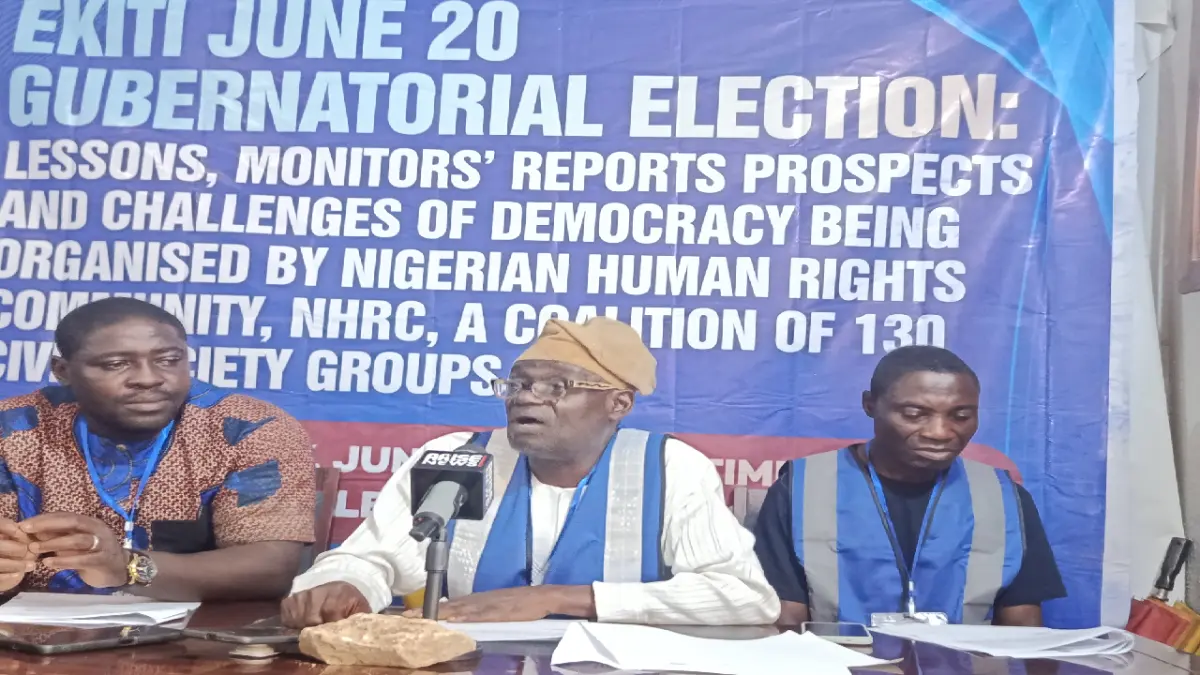
The Nigerian Human Rights Community, NHRC, a coalition of 130 civil society groups, has declared the June 20, 2026 Ekiti State gubernatorial election credible, free and fair, while simultaneously sounding a clarion call for urgent electoral reforms that would deepen democratic participation in the country.
Addressing journalists in Lagos on Wednesday, the leadership of the coalition comprising Martins Adeleke, Fred Ojinika and Akinwale Kasali delivered a comprehensive post-election report that balanced genuine praise for the conduct of the poll with sharp recommendations drawn from field observations by its 200 monitors deployed across the state.
The NHRC’s verdict was unambiguous on the fundamentals. The election, monitors said, reflected the true democratic expression of the Ekiti people, it was peaceful, orderly and largely devoid of the violence, ballot snatching and political brigandage that had long plagued elections in the state.
“Compared with global standards, the election meets international expectations,” the coalition declared, crediting the Independent National Electoral Commission, INEC, with ensuring real-time transmission of results, making the voting process transparent, truthful and accountable.
Particular commendation went to INEC Resident Commissioner Dr. Bunmi Omoseyindemi and his team, whose professionalism monitors said set a new benchmark for electoral administration in Ekiti State.
The deployment of Bimodal Voter Accreditation System, BVAS, machines was highlighted as a game changer, effectively neutralising the manipulation of voter registers and rendering ballot stuffing unattractive to political thugs.
Out of 1,059,360 registered voters, 1,028,929 collected their Permanent Voter Cards, PVCs. Voting materials were distributed across 177 wards in 16 Local Government Councils and 19 Local Government Development Areas.
Incumbent Governor Biodun Oyebanji of the All Progressives Congress, APC, won by a commanding margin, polling 319,224 votes against his closest rival, Dr. Wole Oluyede, who garnered 40,553 votes. Ambassador Dare Bejide of the African Democratic Congress, ADC, came a distant third with 12,872 votes across a field of 13 political parties.
The monitors noted that the APC’s dominance was evident even in the polling units of opposition candidates.
At Oluyede’s own polling unit, APC scored 84 votes to his 113, a razor-thin margin in the opposition candidate’s home base.
In Ikere, Oluyede’s stronghold, APC won in many units. At Bejide’s polling unit, APC polled 140 votes to ADC’s 37, with PDP managing just two.
The NHRC attributed Oyebanji’s landslide to several factors, an aggressive APC campaign blitz that included marketplace engagements and extensive pamphleteering; the structural advantage of incumbency; a superior party structure embedded across wards and polling units; and the deployment of the South West Independent Campaign Movement, SWICAM, which drew campaigners from across Kwara, Kogi, Delta and Edo States to energise Ekiti voters at multiple social and cultural levels.
While the NHRC’s report was largely positive, the coalition was equally candid about the structural gaps the election exposed, gaps they argued, that must be addressed if Nigeria’s democracy is to mature.
Turnout on June 20 fell below the African average, a trend the NHRC described as alarming.
The coalition pointed to poor economic conditions affecting voters’ ability to afford transportation to polling units, security fears, and declining public confidence in democracy’s dividends as key drivers. “INEC and the political parties need to do a lot to encourage people to come out and vote,” the coalition urged, describing voting as one of the most significant civic duties of every Nigerian.
The coalition called for a dedicated timetable for professionals likely to be on duty on election day; health workers, journalists, security operatives and hospitalised patients. It pointed to Ghana’s constitutional provision for Special Voters as a model Nigeria should emulate.
The NHRC renewed calls for an amendment to the Electoral Act to accommodate independent candidates, arguing that the current party-only framework shuts out credible but financially constrained Nigerians from electoral competition.
INEC must create special provisions for elderly voters, pregnant and nursing mothers, and People Living With Disabilities, PLWDs who cannot endure long queue waits, the coalition insisted.
With only approximately 2,000 polling units across the state, many communitie, including Iloro, Ipoti, Itapaji, Irele Ekiti, Agbado and Ikoro are underserved, forcing voters to travel long distances to cast their ballots. The coalition called for an immediate expansion.
Despite the challenges, the NHRC was firm on the fundamental proposition that democracy remains the only viable path for Nigeria.
“Irrespective of the challenges, democracy remains the best option for Nigerians,” the coalition stated, describing the passion of Ekiti voters on June 20 as an indication of “overwhelming preference for democracy as the best alternative to any other non-representative government.”
The mass celebrations that erupted after results were announced on Sunday, monitors observed, were themselves a testament to the depth of democratic sentiment among Ekiti people and a reminder of what credible elections can do for public trust in institutions.
The NHRC’s report now joins a growing body of civil society election monitoring literature pressing Nigeria’s legislature and electoral authorities to convert lessons from each election cycle into concrete reforms, before the next vote arrives.
