


United Nations independent expert, Professor Damilola Sunday Olawuyi, SAN has called for bold, innovative and homegrown reforms that sustain accelerated trade and investments in Africa, without jeopardising human rights.
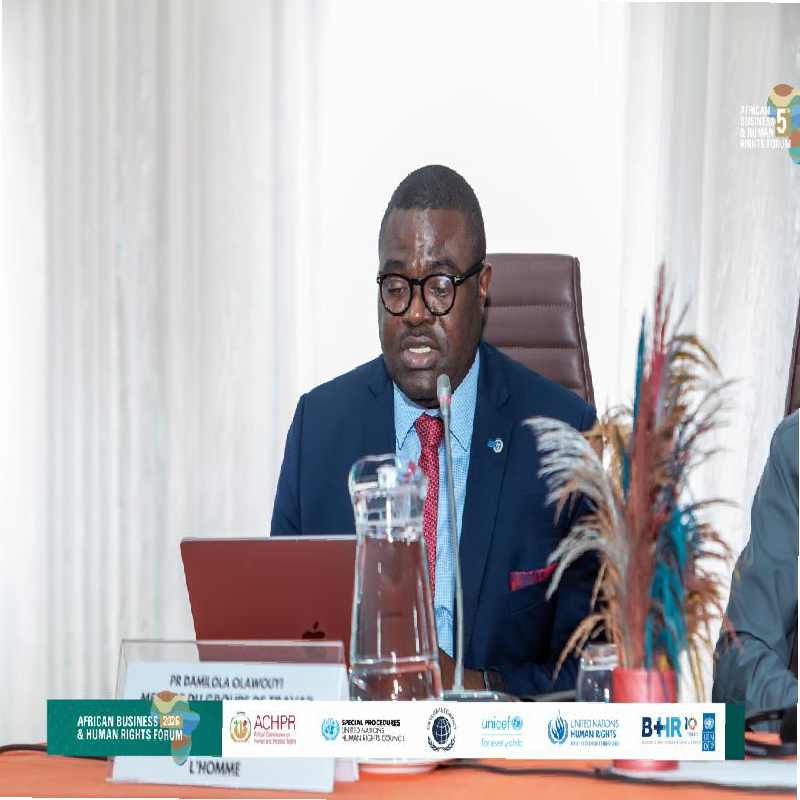
The Senior Advocate of Nigeria, who is also UNESCO Chair on Environmental Law and Sustainable Development at Hamad Bin Khalifa University, Qatar made this recommendation in Dakar, Senegal during his high-level plenary address to the 5th Africa Forum on Business Human Rights.
First held in Accra, Ghana in 2022, the Forum has grown to become the leading platform in Africa that brings together governments, businesses, civil society, international organisations and youth to advance responsible investment in all economic sectors.
Held under the theme: “Realizing the Right to a Clean, Healthy and Sustainable Environment through Responsible Business Conduct,” this year’s Forum brought together close to 1000 participants and high-level speakers both in person and online, including the Minister for Justice, Keeper of the Seals of Senegal, Moussa Sarr, as well as representatives of the United Nations High Commissioner for Human Rights, OHCHR, United Nations Development Program, UNDP, UNICEF, African Union, African Commission on Human and Peoples Rights amongst other dignitaries.
While highlighting the solemn importance of this year’s Africa Forum which marks 15 years anniversary of the adoption of the United Nations Guiding Principles on Business and Human Rights, UNGPs, and the 5th edition of the Africa Forum, Olawuyi called for bold, innovative and homegrown win-win solutions that sustain accelerated trade and investments in Africa, without jeopardising human rights.
Describing foreign investment and trade as crucial to unlock economic growth, employment, and sustainable progress across the continent, Olawuyi cautioned that we must however never lose sight of the long-term, and often irreversible impacts and risks of business operations to workers, communities, indigenous communities, consumers, human rights defenders and other groups at risk, if not managed responsibly, in alignment with international best practices, such as the UNGPs.
He cited recent concerns on how rapid technological advancement and the expansion of data centres and the digital economy are creating both new opportunities and risks for water, energy and the environment, across the continent.
He emphasised that a right-based approach to trade, investment and economic development can ensure that projects or infrastructure that may adversely impact societal well being, as well as the right to a clean, healthy and sustainable environment, are not approved to proceed, irrespective of their economic value.
According to him: “The next 15 years of the Business and Human Rights agenda in Africa calls for bold, innovative and homegrown win-win solutions that sustain accelerated trade and investments in Africa, without jeopardising human rights.
“A win for human rights, is a win for businesses, especially in terms of mitigating reputational and regulatory risks, cementing host community support and having a motivated and dedicated workforce amongst others. On the other hand, a win for businesses in terms of unlocking new clean technologies, unlocking clean energy and sustainable entrepreneurial solutions, is a win for human rights, especially the right to a clean, healthy and sustainable environment.”
He therefore called on all countries, investors and businesses to continue to place human rights due diligence at the heart of investment decision making and planning.
While emphasising the need for capacity development, human rights awareness and education to foster such win-win entrepreneurial solutions, Olawuyi stated that “we cannot import our way to a secure, sustainable and rights-based future, so we must innovate locally.”
Olawuyi called on states and businesses to provide more financial and technical support to clean energy innovators, national human rights institutions, higher education institutions, media, civil society organisations, indigenous caucus and human rights defenders to continue their important work of sensitising the public on the different platforms and mechanisms for accessing remedy and for ventilating their concerns in a manner that sustains peace and sustainable development.
He noted that advancing human rights education and reorientation can unlock youth-led entrepreneurship and innovation that drives a sustainable and prosperous economy.
Noting that a ‘whole government approach’ is required, Olawuyi challenged all stakeholders to align words with actions by stepping up their implementation of the United Nations Guiding Principles on Business and Human Rights.
