


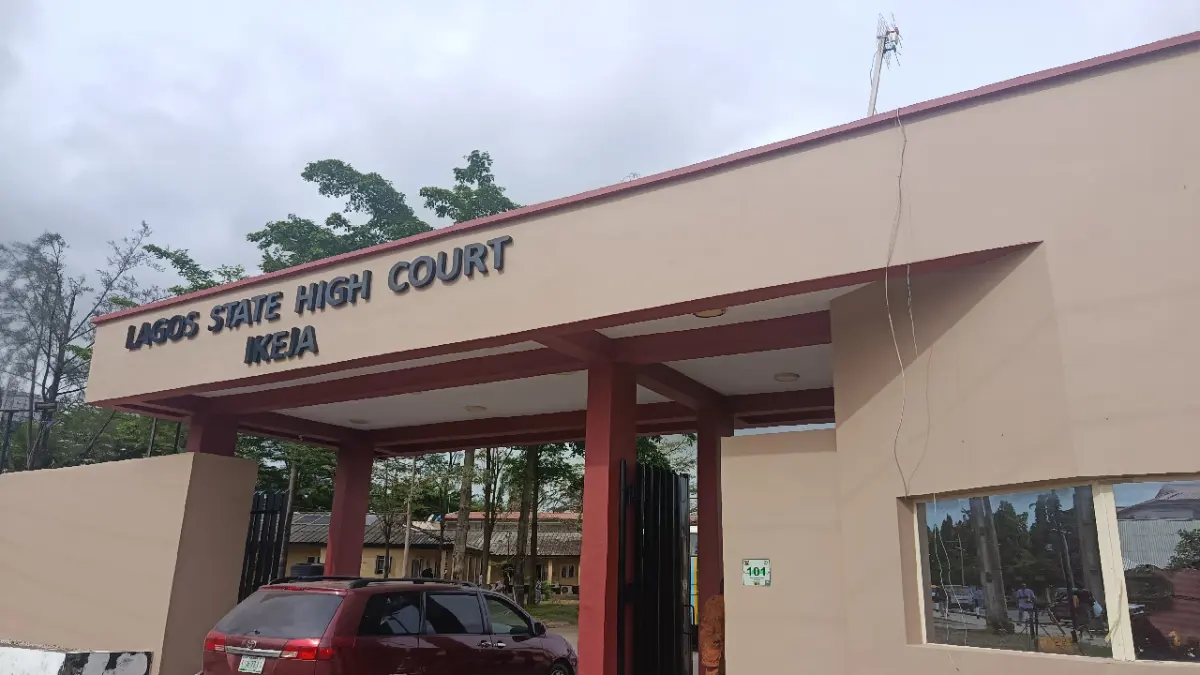
A 58-year-old father, Taiwo Oyelabi accused of raping his 21-year-old biological daughter is now walking home as a free man following the failure of the prosecution to prove the allegation of rape against him, a Lagos State Sexual Offences and Domestic Violence Court, Ikeja has explained.
However, the court came to the conclusion that the father has been having sexual relations with his daughter.
The court discharged and acquitted the defendant, as it chided the failure of the prosecution to present the daughter as a witness throughout the trial.
The suspect was freed because the prosecution failed to establish that the sexual intercourse was without the daughter’s consent, did not call her as a witness and relied on a confessional statement that was rejected for failing to comply with statutory requirements.
Justice Rahman Oshodi delivered the judgement on Thursday, holding that although the prosecution established that sexual intercourse occurred between the defendant and his daughter, it failed to prove the essential ingredients of rape beyond reasonable doubt.
Oyelabi had been charged with a one-count offence of rape, contrary to Section 260 of the Criminal Laws of Lagos State 2015, over an incident allegedly committed in November 2017 at Community Road, Obadore, Igando, Lagos.
The case followed information received by the police on April 16, 2018, alleging that a man was having sexual intercourse with his biological daughter.
According to Justice Oshodi, the prosecution called only one witness, ASP Iyabo Bakare, attached to Igando Police Station.
ASP Bakare told the court that she and her superior officer visited the location following the report and brought Oyelabi and his daughter to the police station.
She further testified that the daughter made a statement alleging that her father had been having sexual intercourse with her since she began living with him.
The police witness also told the court that Oyelabi admitted having an affair with his daughter and impregnated her.
However, the prosecution’s reliance on the defendant’s written confessional statement suffered a setback when the court rejected it following a mini-trial.
Justice Oshodi ruled that the statement was not recorded in accordance with Section 9(3) of the Administration of Criminal Justice Law of Lagos State 2015.
The failure to comply with the statutory requirements made the statement inadmissible, depriving the prosecution of an important piece of evidence it sought to use against the defendant.
Beyond the rejected confession, the judge faulted the prosecution’s case, for failing to present the alleged victim as a witness.
Justice Oshodi observed that the daughter was the person who could directly tell the court whether she consented to the sexual intercourse, but the prosecution did not call her to testify.
Instead, the prosecution relied on Bakare’s account of what the daughter allegedly told her at the police station.
The judge held that this amounted to hearsay and could not establish the absence of consent.
Under the rules of evidence, a witness generally cannot establish the truth of another person’s statement merely by repeating what that person allegedly said outside court.
The judge consequently distinguished between proving that sexual intercourse occurred and establishing that rape was committed.
He said the prosecution’s evidence established the former but failed to prove the latter.
“The evidence shows that the defendant had sexual intercourse with his daughter. It does not show that he raped her,” Oshodi said.
Justice Oshodi further stressed that the prosecution had a duty to prove every ingredient of the offence beyond reasonable doubt, adding that no defendant could be convicted on suspicion, however grave the allegation.
The judge also expressed concern over Oyelabi’s prolonged detention, noting that he had remained in custody since his arrest on April 16, 2018, and spent more than eight years awaiting the conclusion of the trial.
He commended the defence counsel, Mr. Onome Akpeneye, for representing the defendant without payment since his arraignment before the court on December 9, 2021.
Having found that the prosecution failed to establish the rape charge through sufficient admissible evidence, Justice Oshodi found Oyelabi not guilty and discharged and acquitted him.
