


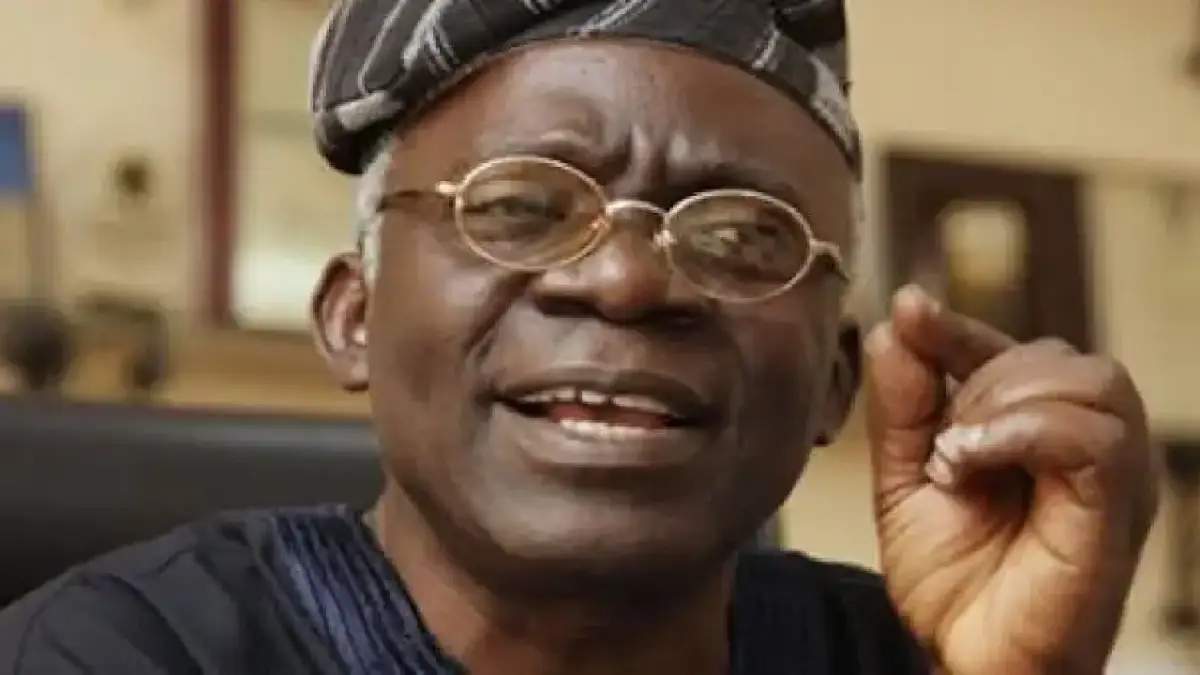
A Senior Advocate of Nigeria, Femi Falana, has described as unconstitutional and dangerous the recent use of teargas on protesters by the police at a protest against alleged illegal demolitions and forced evictions in the Makoko waterfront area.
Falana spoke during a visit to the Lagos State University Teaching Hospital, LASUTH, where injured protesters during the demonstration are receiving treatment.
An activist, Comrade Hassan Taiwo, alias Soweto, and Mr. Dele Frank organised the protest last Wednesday to demand an end to the demolition exercise affecting waterfront communities.
The action was intended to draw the attention of the Lagos State Government to what the organisers described as illegal demolitions and forced evictions.
Afterwards, the protest became violent following the firing of teargas by the police at the demonstrators.
Reports say several protesters sustained injuries during the operation, an action that has since drawn condemnation from human rights advocates and civil society groups.
Nurse gives medical update on injured protester
Briefing the senior lawyer on the condition of one of the victims, a Burns and Plastic Nurse at LASUTH, Mr. Adedeji Hassan, said Mrs. Kafayat Muftaudeen, who sustained a severe leg injury, was being discharged yesterday but that she would continue treatment through regular wound dressing and weekly hospital visits before undergoing surgery.
He said that she was fit to go home and then be coming to hospital as an out-patient for the wound dressing.
“She will be getting her leg dressed regularly, and she will be coming to the hospital weekly,” Hassan said.
When Falana asked if her being discharged was based on financial treatment plan influenced by financial considerations, Hassan insisted that money was not a factor.
It’s not about money,” the nurse said. “Rather than wasting money, if the wound can be salvaged at home, it is better. Dressing will be going on simultaneously with her care in the hospital.”
He added that once the wound is healed, Mrs. Muftaudeen would undergo skin grafting.
“When the wound is fully healed, she will come back for skin grafting . We will take skin from another part of her body to cover the defect. That process is called skin grafting,” Hassan said.
He explained that Mrs. Muftaudeen was being discharged with all her medications and would be monitored by a medical colleague living close to her residence.
“Some people recover better at home, in an environment they are used to, she will be coming every Thursday for check up,” he said.
“She will be coming every Thursday for check up.”
Hassan also revealed that another protester who sustained injuries during the protest had been discharged.
“The other man has been discharged,” Hassan said, adding that he was the individual whose injury was shown in footage aired by CNN.
Falana cites constitutional, legal protections
Falana said the Nigerian Constitution clearly guarantees freedom of expression and freedom of assembly.
“My position is that the Constitution of Nigeria has guaranteed freedom of expression and freedom of assembly,” Falana said.
He recalled that the Court of Appeal, in All Nigeria Peoples Party, ANPP vs. Inspector General of Police, affirmed the right of Nigerians to protest peacefully and directed the National Assembly to enact laws to protect that right.
The senior lawyer further explained that the Police Establishment Act further strengthens those protections.
“In 2020, the Police Establishment Act specifically provides that those who want to protest are only required to notify the police, once the police command is notified, adequate security must be provided,” Falana said.
He explained that the organisers of the protest complied with the law by notifying the police in advance, adding that officers escorted the protesters peacefully from Ikeja Under Bridge to the Alausa Secretariat.
“From Ikeja, under the bridge, up to Alausa, the protesters marched peacefully without disturbing anybody, they were guided by the police around the House of Assembly complex, Falana said.
He said the situation changed when no government official came out to receive a letter addressed to the Lagos State Governor.
“The protesters sang some songs which the police considered offensive, and at that stage decided, at very close range, to tear gas the protesters,” Falana said.
Falana expressed concern over the injuries sustained by some demonstrators, describing them as unusual.
“The injury I’ve seen is not normal. I’ve taken part in protests in this country for over 40 years. I’ve never seen a situation where a tear gas canister would pierce somebody’s skin to that level.”
The legal practitioner opined that expired tear gas canisters may have been used during the operation.
“It is possible that some of the canisters have expired,” Falana said.
He also stressed that singing abusive or vulgar songs does not constitute a criminal offence under Nigerian law.
“It is not the law in Nigeria that you will be brutalised for singing abusive songs,” he highlighted.
“Our courts have insisted that vulgar abuse cannot constitute an offence.”
Citing another decision of the Court of Appeal, Falana said public officers must tolerate criticism in a democratic society.
“The court advised that if a public officer is too sensitive or irascible, he should cover his ears with cotton wool. Criticism is indispensable in a democratic society” he said.
“You don’t need police permit to protest”
He countered claims that protesters require police permission before demonstrating.
“You do not need police permit to protest. Police permit has been described by the Court of Appeal as a relic of colonialism.”
He maintained that under the Police Establishment Act, protesters are only required to notify the police of their intention to march.
“All the law requires is notification,” he said. “The police are duty-bound to provide security.”
“The whole idea of protesting is to draw attention to your demands,” Falana said. “If you confine protesters to a corner, how would the government know that people are protesting?”
Falana said he hoped lessons would be learnt from the incident.
“You can’t give people their rights with one hand and take them back with the other,” he said.
