


For many, a golden jubilee evokes celebration and nostalgia, but 50 years after the creation of Nigeria’s capital city, Abuja, its original inhabitants remain seemingly helpless, burdened by unresolved plights that have now taken centre stage.
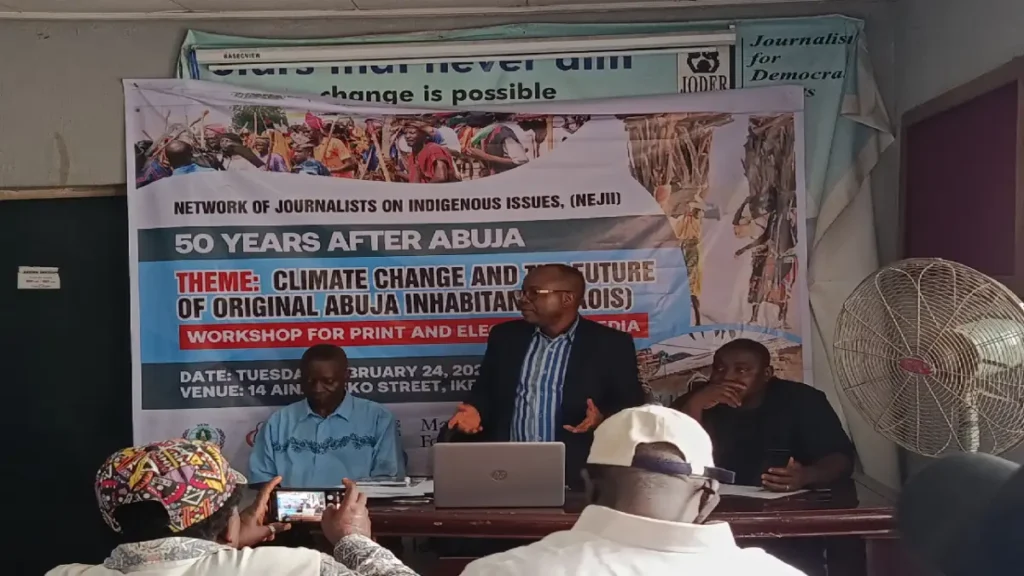
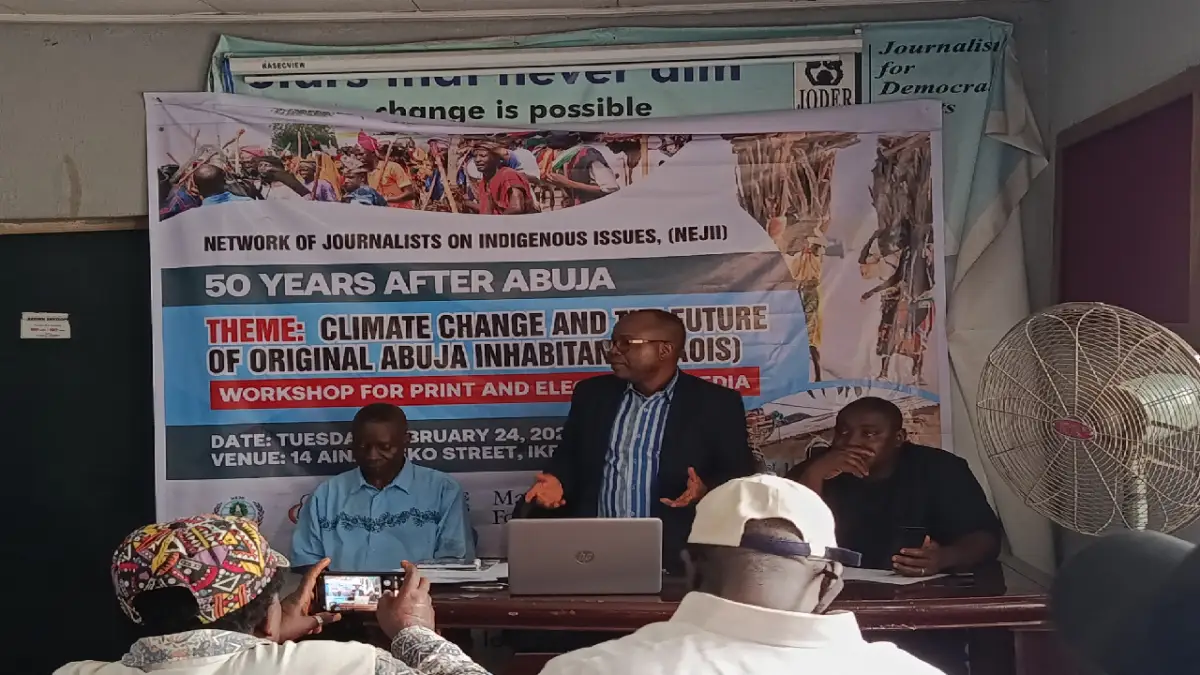
Their concerns came to the front burner on Tuesday in Lagos, as stakeholders at a one-day workshop issued a strong call to journalists and policymakers to confront the growing climate crisis threatening the survival of Abuja Original Inhabitants, AOIs.
Abuja original inhabitants
The workshop, organised by the Network of Journalists on Indigenous Issues, NEJII, in collaboration with the Resource Center for Human Rights and Civic Education, CHRICED, with support from the MacArthur Foundation, focused on climate change and its far-reaching consequences for Abuja indigenous communities.
Facilitators described climate change as an existential threat to the Abuja indigenous people, warning that environmental degradation, land dispossession, and lack of consultation continue to endanger their health, livelihoods, and cultural identity.
Delivering a paper at the workshop Mr. Adewale Adeoye, stressed that in traditional societies, “the land and the forest represent motherhood without which life will be void,” noting that the ecosystem remains the pillar of humanity’s existence.
He lamented that Abuja’s indigenous communities, which was estimated at about 2.5 million people across eight ethnic groups including Gwari, Koro, Gade, amongst others have suffered decades of displacement since the Federal Capital Territory was created in 1976.
According to the convener, Adeoye insisted there was no prior consultation before the capital was moved to Abuja, leading to forceful occupation of ancestral lands.
“Imagine you wake up in the morning and you are seeing soldiers everywhere, telling you to move because your town is now the new capital. There was no consultation. There was no discussion,” Adeoye recounted.
He detailed how ancestral graves were exhumed, sacred temples destroyed, and entire communities dispersed to neighbouring states, stripping many of their economic base and cultural heritage.
The impact, he said, has been compounded by climate change, which manifests in flooding, erratic rainfall, rising temperatures, drying streams, biodiversity loss, and disappearing forests.
Environmental degradation, health risks worsen crisis
Participants noted that climate change has disrupted planting cycles, reduced crop yields, and increased cases of malnutrition and water-borne diseases among Abuja’s indigenous communities.
“In some of the communities visited, the same stream used for bathing and washing clothes is the same stream used for drinking because there is no access to clean water,” the paper revealed.
The destruction of forests and medicinal plants, they said, has eroded indigenous knowledge systems that once sustained local healthcare and food security.
Physical health challenges now include increased infectious diseases, while mental health concerns such as depression and anxiety have intensified due to land loss, poverty, and cultural dislocation.
“Climate vulnerability is not only environmental; it is economic and existential,” the speaker stressed.
Mining activities, deforestation, unchecked urban expansion, and alleged land allocations without adequate environmental impact assessments were also identified as drivers of flooding and erosion in rural settlements around Abuja.
Journalists urged to amplify indigenous voices
Speaking at the event, Olalekan Adetayo, one of the facilitators described climate change in Abuja as “local, immediate and ancestral.”
“Climate change is often discussed in global statistics. We talk about rising sea levels and carbon emissions. But for Abuja original inhabitants, it is what they see with their physical eyes every time,” he said.
He urged journalists to go beyond routine event coverage and investigate structural causes of environmental injustice.
“Humanise climate stories. Don’t just throw figures. Put faces to those displaced. Spotlight indigenous voices. Track government spending and environmental policies. Good journalism can prevent conflict and hold institutions accountable,” he urged.
Participants also called for recognition of customary land rights, inclusive land dialogue, culturally appropriate climate adaptation policies, and respect for prior informed consent in land-related decisions.
They warned that continued marginalisation could deepen poverty, trigger further displacement, and heighten social tensions.
Speakers concluded that climate change in Abuja is not abstract but a lived reality for indigenous communities whose ancestral lands now host Nigeria’s capital.
“The future of the Federal Capital Territory cannot be separated from the future of its original inhabitants,” Adetayo opined.
.
.
.
