


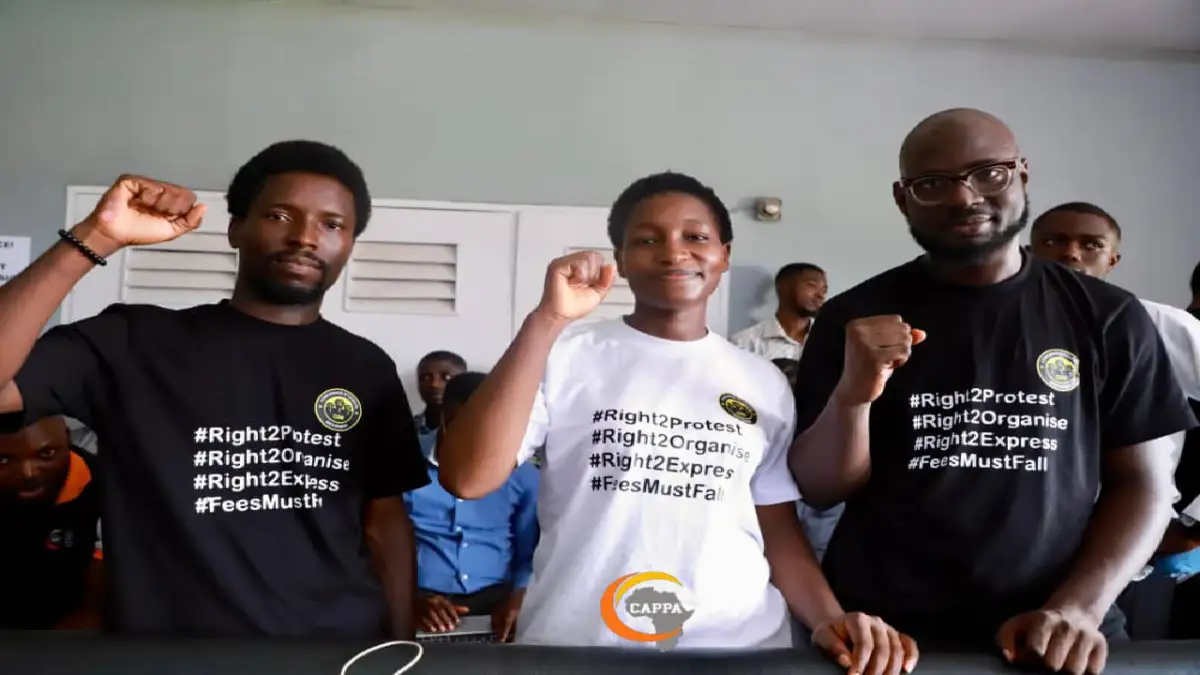
A Federal High Court sitting in Ibadan, Oyo state on Wednesday overturned the suspension of Ayodele Aduwo, Mide Gbadegesin, and Nice Linus, three students of the University of Ibadan sanctioned after staging a peaceful protest against fee hikes.
Communicating about the development, Robert Egbe, Media & Communications Officer of the Corporate Accountability and Public Participation Africa, CAPPA.
Recall that sometimes last year, the students were arrested by the school’s internal security, beaten to stupor, abused and handed over to the military for detention simply because they quietly and peacefully held up placards reading “No to school fees hike” during a student event.
Delivering a landmark judgement, Justice N. E. Maha nullified the rustication of the students and affirmed that their suspension violated their constitutional rights to freedom of thought and expression.
Ordeal of victimised University Of Ibadan students exposed
Details presented before the court revealed that the students’ ordeal began on May 13, 2024, when they quietly displayed placards reading “No To Fee Hike” and “#FEESMUSTFALL” during a Students’ Union event.
According to testimony in court, the students were forcefully removed by university security, assaulted, and handed over to a mob that beat and humiliated them before transferring them to military personnel.
The trio testified that they were forcibly removed from the venue by school authorities, physically assaulted, and, after a year-long campaign of intimidation and harassment by university authorities, were subjected to disciplinary proceedings that led to the suspension of Ayodele and Gbadegesin for four semesters.
While Nice Linus was not formally suspended, she has continued to experience maltreatment, including being denied the opportunity to resume her role as a legislator on the UI Student Representative Council despite securing a majority mandate in the election.
The students filed a suit in court challenging their suspension and alleging victimisation for exercising their right to peaceful expression.
Furthermore, they asserted that the punishment was intended to silence lawful dissent.
CAPPA described the situation as a troubling pattern in academic institutions across the country, whereby student activism, especially against rising school fees, is increasingly met with intimidation, suspension, and institutional repression.
The group commended Ayodele, Gbadegesin and Linus “for their sacrifice and courage” in standing for their rights and urged other students across the country to draw inspiration from their victory.
It also praised the diligence of lead counsel, Joseph Opute Esq., and his co-counsel O. Onifade, whose legal representation was central to securing the judgement.
The organisation expressed satisfaction in its role in the students’ triumph and pledged to continue to support oppressed students across the country.
“We are proud, not only of Ayodele, Gbadegesin and Linus, but also of our role in helping them assert and defend their rights. We are proud to have stood by them since their ordeal began, amplifying their voices through our advocacy and media networks, and facilitating legal services for them.” CAPPA said.
“We pledge to continue rendering support to other Nigerian students defending their constitutional rights across the country.”
According to the CAPPA, “universities should be spaces where ideas are contested, where authority is questioned, and where future leaders are trained not just to comply, but to think critically and act courageously. When administrations resort to suspensions, rustications, and intimidation, they turn campuses into zones of fear rather than forums of debate. This is dangerous and unacceptable.”
Ibeh described the issue as a systemic attempt to shrink civic space within Nigerian higher institutions.
“When students are punished for peaceful protest, the message is that lawful dissent will not be tolerated. What kind of society punishes its young people for caring enough to speak?” she added.
Calling on university authorities to recognise students as stakeholders rather than adversaries, CAPPA demanded that fee policies and other developments affecting students be subjected to transparent, participatory processes that consider the socio-economic realities of students and their families.
“Chronic underfunding of the education sector has shifted the burden onto vulnerable students, creating a system where access is increasingly determined by wealth rather than merit. Until this structural issue is resolved, protests will persist, and rightly so,” CAPPA added.
Justice Maha noted that the university authorities “did not deny these damning allegations.”
Following the incident, the institution imposed disciplinary measures, including a four-semester suspension for two of the students, a decision now voided by the court.
The suspension, CAPPA argued, was part of a broader attempt to silence dissent within academic spaces.
CAPPA demands compliance, apology
Reacting to the ruling, CAPPA called on the university to immediately reinstate the affected students and issue a public apology for its actions.
“The court’s decision sends an unequivocal message… that tyranny and the use of authoritarian tactics to stifle legitimate dissent is unlawful, unacceptable and will not stand,” said Zikora Ibeh, CAPPA’s Assistant Executive Director.
The organisation stressed that suspension of the students reflects a troubling trend where student protests, particularly against rising fees, are met with intimidation and repression.
CAPPA also commended the courage of the students and the legal team led by Joseph Opute Esq., noting that their persistence led to justice.
A defining moment for student rights
The ruling marks a significant pushback against what CAPPA described as shrinking civic space in Nigerian universities.
It warned that continued suppression of student voices could turn campuses into “zones of fear rather than forums of debate.”
By overturning the suspension, the court has reinforced the principle that universities must remain spaces for critical thinking and lawful expression.
