


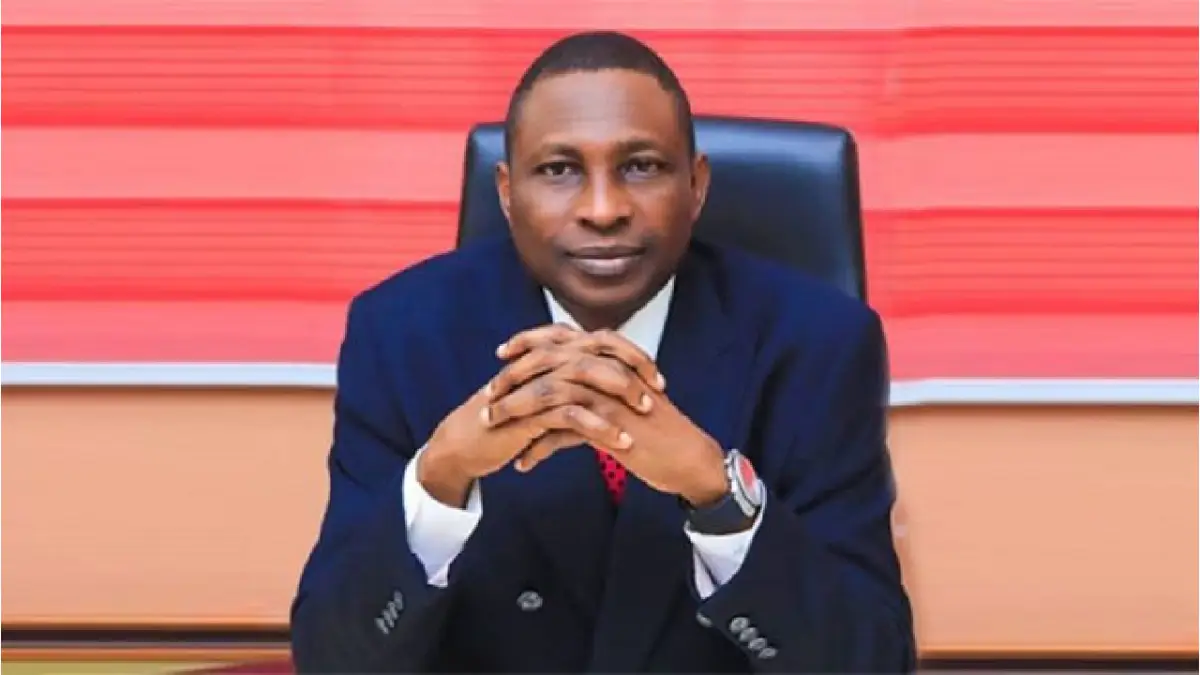
The Executive Chairman of the Economic and Financial Crimes Commission, EFCC, Mr. Ola Olukoyede, has warned Nigerians against the abuse of the naira, saying that spraying and stamping on the national currency is not part of Nigerian culture but a criminal offence.
Olukoyede gave the warning on Friday in Lagos during a stakeholders’ sensitisation programme held in Lagos.
Naira abuse, criminal offence
Describing the naira as “a symbol of our sovereignty,” the EFCC boss expressed concern over persistent abuse of the currency at social functions, particularly through spraying, mutilation, and stamping.
“Nobody who works hard to earn money will go out and start throwing their hard-earned salary in the air,” he said.
He added that the EFCC, in partnership with the Central Bank of Nigeria, CBN, had set up a Task Force on Dollarisation and Naira Abuse to enforce the law against unlicensed foreign exchange dealers and currency abusers.
“There is nothing cultural about destroying our national currency,” he said.
Olukoyede said that arguments suggesting the Commission should focus only on high-profile financial crimes were misplaced.
Consequences
“An offence is an offence. Ignorance of the law is never an excuse,” he said, adding that several celebrities already facing prosecution could attest to the consequences.
He noted that the EFCC had adopted a new approach beyond enforcement to protect jobs and investments while promoting economic recovery.
According to him, the Commission no longer shuts down companies under investigation arbitrarily, but now follows operational protocols that safeguard legitimate businesses.
He said over N100 billion in recovered proceeds of crime had been redirected into social intervention projects under the Tinubu administration, including the Nigerian Education Loan Fund, NELFund and the CrediCorp consumer credit scheme.
“These are not just headlines — they are real interventions funded by money recovered from corrupt individuals and organisations,” he said.
Olukoyede disclosed that a landmark recovery from the Niger Delta Development Commission, NDDC, enabled the establishment of a skill acquisition centre and a liaison office in Bayelsa State.
He also said that a property recovered from a former civil servant in Kaduna had been converted into the newly established Federal University of Applied Sciences, Kachia.
The EFCC chairman revealed that the Commission was collaborating with foreign governments to recover and restitute stolen assets and had repaid fraud victims in the United States, Spain, and Canada.
EFCC highlights
He said recent sting operations in Lagos and Abuja had led to the arrest of 792 suspects involved in an international criminal ring, with over 150 Chinese nationals among those prosecuted.
Olukoyede assured Nigerians that politically exposed persons were not exempt from prosecution, disclosing that four former governors and three ex-ministers were currently being tried for corruption-related offences.
To strengthen prevention mechanisms, he announced the creation of a Department of Fraud Risk Assessment and Control, FRAC, within the EFCC.
He added that the Commission runs EFCC Radio 97.3FM and holds weekly sensitisation programmes on radio, television, and social media platforms.
“We all must lend our voices to this national campaign to restore the integrity of the naira. This fight is not for EFCC alone — it is a collective duty, towards criminal offence,” Olukoyede said.
