


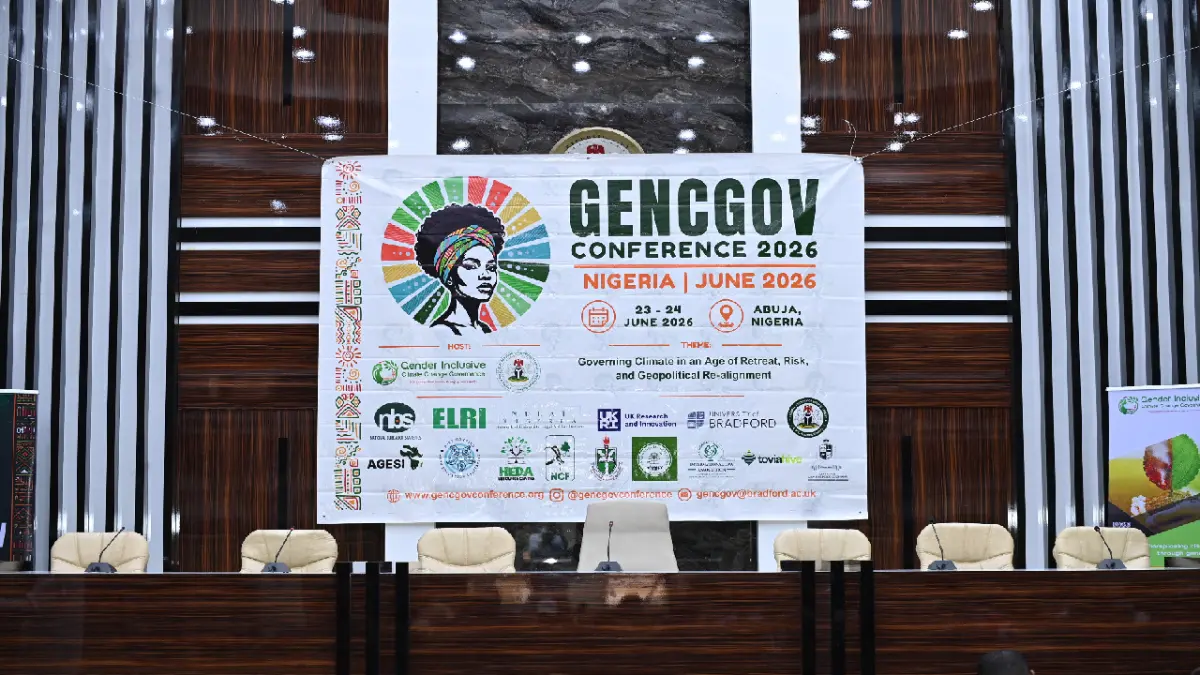
Policymakers, academics, climate governance experts, development partners and civil society leaders have called for stronger accountability, inclusion and evidence-based climate action at the close of the Gender-Inclusive Climate Change Governance, GENCGOV International Conference 2026 in Abuja.
The two-day conference, held from June 23 to 24 at the Federal Ministry of Education, brought together stakeholders from government, academia, civil society, the media, diplomatic community, youth networks and community organisations under the theme, “Governing Climate in an Age of Retreat, Risk and Geopolitical Re-alignment.”
Participants examined the growing challenges facing climate governance and explored practical pathways for strengthening climate justice, accountability, and resilience.
GENCGOV is funded through the UK Research and Innovation, UKRI Future Leaders Fellowship, FLF, and seeks to strengthen gender-inclusive approaches to climate change governance by bringing together researchers, policymakers, practitioners and communities to generate evidence and promote more equitable climate action.
Among the notable participants were Yusuf O. Kelani, Senior Special Assistant to the President on Climate Change Matters; Professor Abdullahi Yusuf Ribadu, Executive Secretary of the National Universities Commission, NUC; Professor Olanrewaju Fagbohun, SAN, Director of the Environmental Law Research Institute, ELRI; Professor Abdulqadir Ibrahim Abikan, Director-General of the Nigerian Institute of Advanced Legal Studies, NIALS; Dr. Juliana Stoyanova of the British High Commission; and Engr. Umar A. Umar, Executive Director, Technical Services, Rural Electrification Agency, REA, who represented the Agency’s Managing Director and Chief Executive Officer.
Representatives of the Federal Ministries of Women Affairs, Environment, Regional Development, Agriculture and Food Security also participated in the conference.
The conference was convened by Dr. Pedi Obani, Associate Professor at the University of Bradford and GENCGOV Global Research Lead, who stressed the need for collaborative approaches to climate governance and for climate policies to be rooted in the realities of affected communities.
“Climate injustice is not confined by borders. But the solutions that work must be grounded in the realities of each country, each community, and each institutional context,” she remarked.
In his welcome address, Kelani, one of the organising partners of the conference, described climate change as a pressing reality rather than a distant threat.
“Climate change is no longer a future challenge; it is a present reality,” he said, noting that its impacts are increasingly evident through flooding, desertification, food insecurity, migration and rising social inequality.
He further stressed the importance of partnerships in responding to the climate crisis.
“No single institution can solve the climate change problem. Success requires collaboration,” Kelani stated, urging greater cooperation among government institutions, researchers, civil society organisations and local communities.
A major focus of the conference was the need to ensure that women, young people and vulnerable populations are not only beneficiaries of climate interventions but active participants in shaping climate policy and governance.
Speakers argued that climate governance structures remain overly centralised and frequently fail to reflect the experiences of frontline communities.
Dr. Obani underscored the importance of collective responsibility and inclusive decision-making throughout the conference.“Climate governance is strongest when it is shared,” she said, a message that resonated across plenary sessions, policy dialogues and research discussions.
One of the major highlights of the conference was the presentation of findings from Nigeria’s first National Household Survey on Climate Change with a dedicated gender dimension, implemented by GENCGOV in partnership with the National Bureau of Statistics, NBS.
The findings provided new insights into how climate change affects households across different climatic zones and highlighted significant gender dimensions in climate vulnerability, adaptation, and resilience.
Participants emphasised the importance of gender-disaggregated data in strengthening climate governance and informing more responsive and equitable policymaking.
The conference also recognised outstanding contributions to climate governance through the presentation of awards and grants.
Commemorative plaques were presented to distinguished speakers, partners and institutions in recognition of their leadership and contributions to advancing climate governance.
In addition, three grants were awarded to support climate justice initiatives. Lighthope Succour Worldwide Initiative and Town Crier Initiative each received ₦1 million under the GENCGOV Climate and Gender Justice Toolkit Adoption Grant to support the adoption and implementation of the Toolkit within their communities, while Baze University received a ₦750,000 Climate Justice Fellowship Grant to support research and capacity building in climate justice.
The conference also examined climate finance and accountability.
During a high-level panel session, speakers discussed how climate finance can support adaptation and development without reproducing existing inequalities.
Participants called for greater transparency, stronger monitoring mechanisms and improved access to climate finance for vulnerable communities. Other discussions explored the role of the media in shaping public understanding of climate issues, the importance of indigenous knowledge systems, and the contribution of community-led adaptation initiatives to climate resilience. Participants emphasised that effective communication and meaningful public engagement remain critical to strengthening climate governance and advancing climate justice.
Day Two of the conference featured a strong research programme, with more than 30 paper presentations delivered through physical and virtual sessions.
Researchers presented studies on climate finance, governance legitimacy, climate law, accountability, energy transition, climate displacement, climate-smart agriculture, artificial intelligence, youth inclusion and community resilience. International perspectives were also brought into the discussions through contributions from leading climate governance scholars and practitioners, including Professor Joyeeta Gupta of the University of Amsterdam and Professor Patricia Mbote, Director of the Law Division at the United Nations Environment Programme, UNEP, alongside policymakers, legal experts and climate practitioners from Nigeria and beyond.
Participants concluded the conference with a call for stronger collaboration among government agencies, universities, development partners, civil society organisations, the private sector and local communities.
They urged stakeholders to move beyond dialogue toward action and work collectively to build more inclusive, accountable and resilient climate governance systems.
The organisers expressed hope that the conference would strengthen collaboration across research, policy and practice while contributing to more inclusive climate governance in Nigeria and beyond.
Closing on a note that captured the spirit of the gathering, Dr. Obani reminded participants that: “A conference becomes meaningful when it changes what people do after they leave.
”For many participants, that challenge captured the central message of GENCGOV Conference 2026: meaningful climate governance depends not only on dialogue, but on sustained collective action.
GENCGOV, the Gender Inclusive Climate Change Governance project, is a UK Research and Innovation, UKRI Future Leaders Fellowship, FLF research initiative led by Dr. Pedi Obani at University of Bradford, and delivered in partnership with organisations across Nigeria, Kenya, and South Africa.
The project brings together researchers, policymakers, businesses, civil society, and communities to develop practical and inclusive approaches to climate governance.
By promoting gender-responsive and evidence-based climate action, GENCGOV aims to strengthen resilience and ensure that more communities have a voice in shaping climate policy and solutions at local, national, and international levels.
