


Anyone who has come in contact with the Community Service Scheme can easily relate to Gbenga’s lived experience. He is already basking in the joy of a second chance after spending nearly eight years in custody.
An elated beneficiary said, “I am just so excited right now, and I want to give honour to whom honour is due because I am truly glad to be here.
“When I was sentenced to Adigbe, I stayed there for almost eight years. During that time, I felt like life was no longer worth living. But after a while, I realised that the government is actually working to reform people. The mindset I have now is completely different from the one I had when I first arrived.
“I was later assigned to three months of community service and counselling. Even though I received counselling, my mindset back then was still negative. I worked at the Secretariat for those three months: cleaning offices, sweeping, and doing various tasks. Whenever people saw me doing that work, I felt deeply ashamed of myself.
“However, as I was completing my service, Ms. Komolafe called me into her office and said, ‘Gbenga, come.’ She spoke to me encouragingly. While at Adigbe, I learned photography and video recording, and after passing my medical tests, I enrolled at the National Open University.
“Because of that, I wasn’t able to attend the official equipment distribution ceremony; I had to travel from Lagos to Ogun State to stay focused on my studies. I didn’t want to lose that opportunity after everything I had been through just to educate myself. That is why I am so happy today.
“I want to thank the government for this community service programme. It has contributed tremendously to society, and I strongly encourage them to keep it up. I deeply appreciate everything they are doing in the community.”
He emerged carrying painful memories and uncertainty about the future. Yet, through community service, counselling, education, and social support, his narrative shifted from confinement to hope.
His experience offers a human face to a justice policy often discussed strictly in terms of courts, sentences, and correctional facilities.
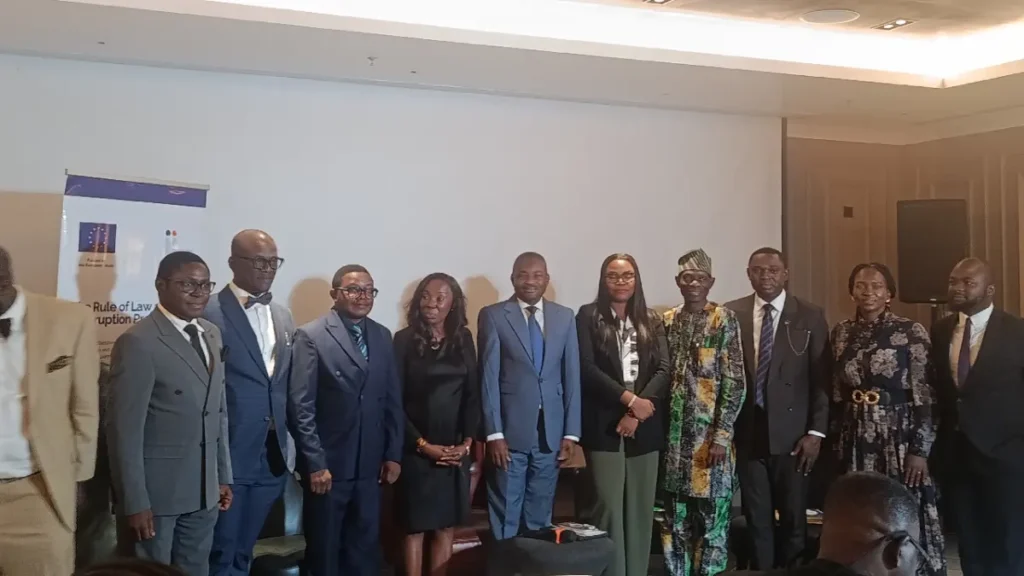
Gbenga shared his testimony alongside other beneficiaries during a stakeholder engagement organised by the Lagos State Ministry of Justice.
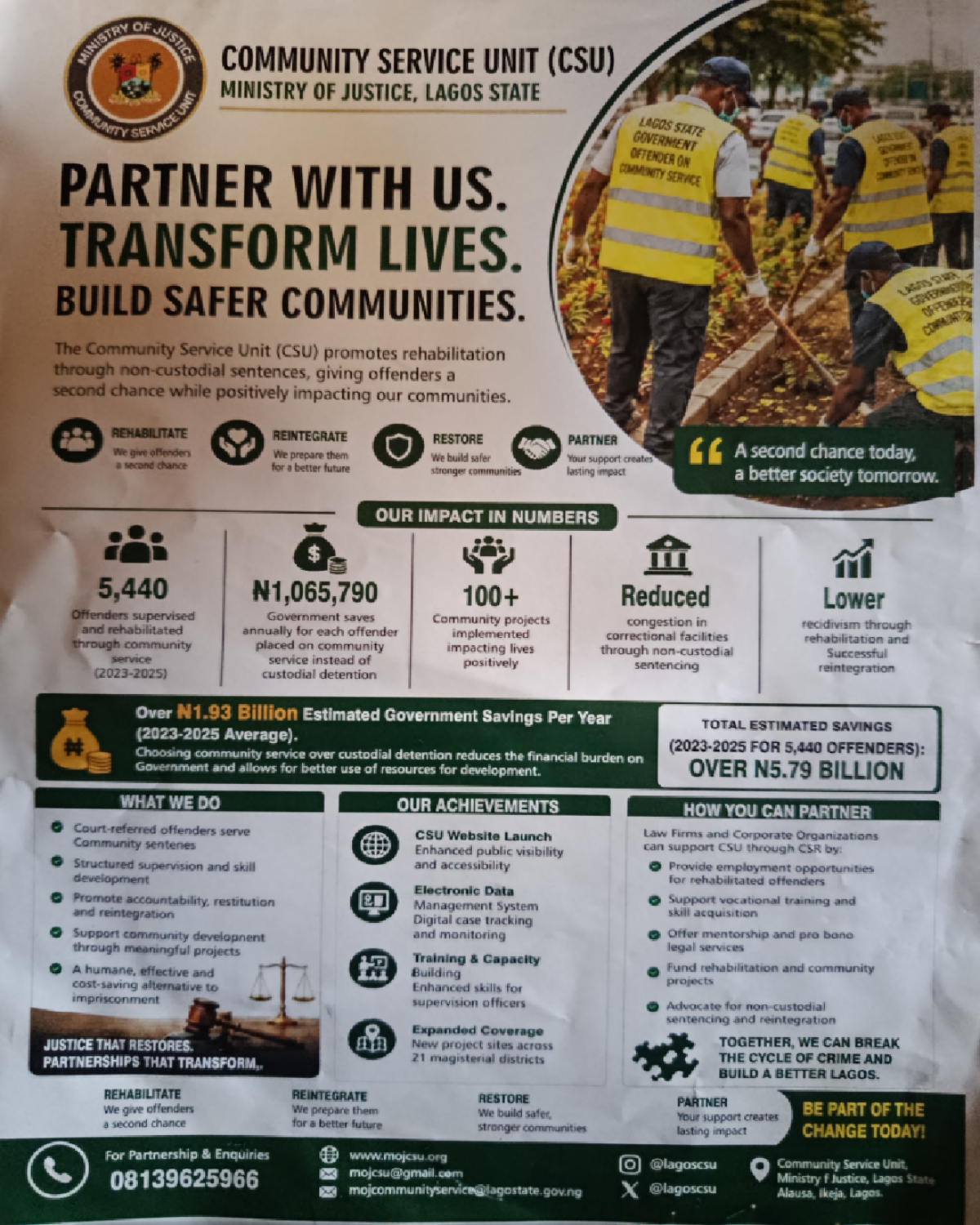
The sensitisation programme highlighted the real-world impact on more than 5,440 offenders supervised and rehabilitated by the Ministry’s Community Service Unit between 2023 and 2025.
When punishment becomes a path to rehabilitation
The Lagos State Ministry of Justice promotes community service as more than just an alternative to imprisonment. The scheme is designed to combine accountability with restorative justice—particularly for minor and non-violent offences where incarceration yields poor outcomes for both the offender and society.
Under the programme, court-sentenced offenders are assessed, placed in government agencies, public institutions, or approved private establishments, and closely monitored. Rather than removing an individual from society, community service encourages them to accept responsibility while contributing positively to their local environment.
From custody to the Community Service Scheme
For Gbenga, that process began with a referral to counselling and a three-month placement at the Lagos State Secretariat doing manual maintenance. At first, he admitted to feeling immense shame working in public view.
However, mandatory counselling helped him confront the negative outlook he had harboured during his incarceration. What started as a punishment gradually became a platform for personal growth.
Having acquired photography and video recording skills while in custody, Gbenga committed to continuing his education. Rather than abandoning his studies, he relocated to Ogun State to pursue his National Open University programme and write his examination—a decision that symbolised a total break from his past.
From stigma to reintegration
Ms. Komolafe Olanrewaju, a Director at the Ministry, speaking on behalf of the Community Service Unit, noted that Gbenga’s dedication to photography prompted the unit to consider supporting him with professional equipment.
However, his story also highlights the biggest hurdle facing former convicts: social stigma.
“Stigmatisation remains a major challenge, Olanrewaju explained. “A person may complete their sentence, yet society continues to punish them through rejection, suspicion, and the denial of opportunities.“
Rehabilitation cannot end at the prison gates. If an individual accepts responsibility, acquires actionable skills, and demonstrates a willingness to change, society must create the space for them to rebuild. Without acceptance, the risk of recidivism rises sharply.
Why stakeholder partnerships matter
To build a sustainable framework, Olanrewaju called on law firms, corporate bodies, professional associations, and civil society organisations to partner with the Community Service Unit.
Ways they can intervene are; To provide structured work placements and job opportunities, offer direct mentorship and skills development, provide social support networks and help eliminate social stigma.
The goal is not to excuse crime, but to ensure that legal accountability leads to a safer, more productive society.
Properly executed non-custodial sentencing reduces pressure on overcrowded correctional facilities and interrupts the cycle of reoffending.
Building a restorative justice system
Earlier, the Director of Public Prosecution, Mr. Adebayo Haroun, of the Ministry of Justice, on behalf of the Honourable Attorney General and Commissioner of Justice, Lagos State, Mr. Lawal Pedro and the Solicitor General and Permanent Secretary of the state, Mr. Hammed Oyenuga, advocated that the administration of criminal justice in any modern society must continually evolve to reflect changing realities and emerging best practices.
According to them, while punishment remains an important component of criminal justice, experience across jurisdictions has shown that sustainable justice outcomes are better achieved when sentencing policies also create opportunities for offenders reform, behavioural change and productive reintegration into society.
It is within this context that the community service scheme occupies a significant place in the justice architecture of Lagos State.
To this end, the Community Service Unit has become an increasingly credible non-custodial option.
However, the Ministry acknowledged ongoing operational hurdles, including limited manpower, low public awareness, restricted placement slots, and logistical constraints.
Overcoming these challenges requires active public-private collaboration. Gbenga’s transition shows that when courts, correctional units, host organisations, and communities form a continuous chain of support, justice can hold individuals accountable without permanently closing the door on their future.
